
This article contains affiliate links. If you buy through them, Smart AI Review Hub may earn a commission at no extra cost to you. As an Amazon Associate I earn from qualifying purchases.
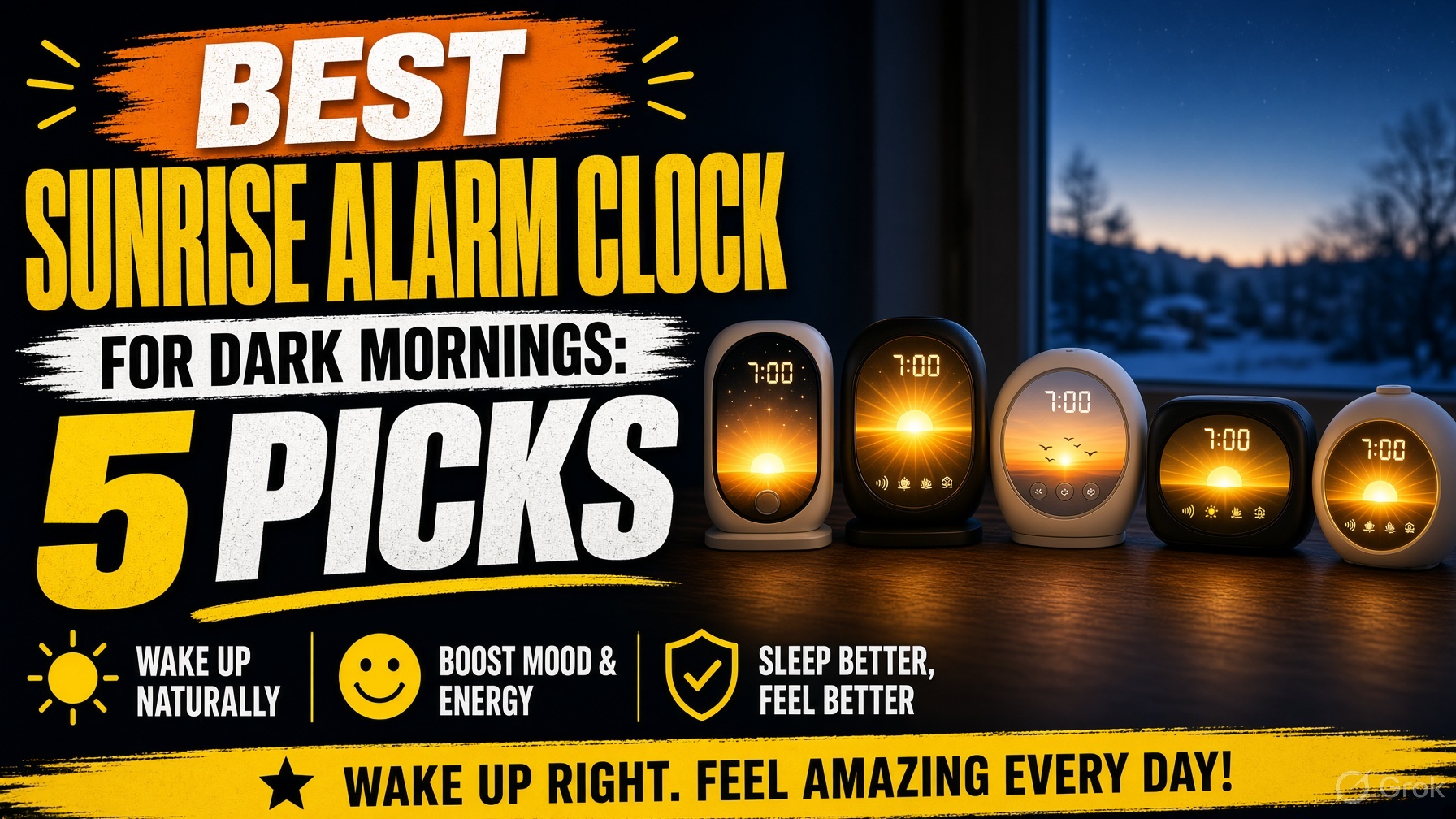
The best sunrise alarm clock for dark mornings depends on how you want to wake up. Choose the Hatch Restore 3 if you want a tailored light-and-sound routine, the Lumie Bodyclock Shine 300 if you want extensive controls without an app, or the Philips HF3520/60 if a straightforward sunrise is your priority. The Philips HF3650/60 adds more bedtime features, while the compact Dreamegg Sunrise 1 pairs a wake light with plenty of built-in sounds.
The key questions are simple: How bright should the light become? Can you change the sunrise length? Do you need a backup sound? And will you tolerate setting an alarm through a phone? Those details matter most when your workday starts before daylight.
Fall makes early wake-ups feel darker as daylight hours shorten. The changing season drives the need for a sunrise alarm; where clocks change in November, that adjustment does not make sunrise occur later by the clock. Pick for your actual alarm time and bedroom, rather than the calendar alone.
Our top picks at a glance
- Best for customized routines: Restore 3 — Check current details
- Best standalone control: Bodyclock Shine 300 — See latest availability
- Best app-free bedtime features: SmartSleep Sleep and Wake-Up Light HF3650/60 — View product specifications
- Best dedicated no-app wake light: SmartSleep Wake-up Light HF3520/60 — Check current details
- Best compact sound-machine pick: Sunrise 1 — See latest availability
How we chose these products
The editorial team selected five US-market models that address different early-morning needs: an app-led routine, a highly adjustable standalone clock, an app-free bedtime companion, a simpler dedicated wake light and a compact sound-machine option. Manufacturer specifications supplied the settings and hardware details. Independent product assessments helped identify practical trade-offs such as control complexity, footprint and the perceived strength of the light. Published lux numbers were kept in context because they do not establish a controlled, head-to-head brightness comparison. Stock and seller details can change, so confirm the exact model before ordering.
1. Best for customized routines: Restore 3
Best for: Sleepers who want detailed light and sound routines and are comfortable setting them up in an app.
Hatch Restore 3 makes the most sense when your alarm is only one part of a bedtime routine. You can adjust the sunrise brightness and duration, choose a wake sound and set repeat days. Physical controls let you move through routine steps at the bedside, which is useful once setup is complete. Hatch says the core sunrise alarm and a basic selection of light and audio remain available without Hatch+; the subscription adds more content.
The catch is the setup. The free Hatch Sleep app, a compatible Bluetooth setup device and 2.4 GHz Wi-Fi are required. That makes Restore 3 a poor fit for someone seeking a clock that never involves a phone or network. Its appeal is the range of routines and sounds, rather than total independence from an app.
Key features
- Per the maker: You can tailor how bright the morning light gets and how long it lasts, then choose a wake-up sound and the days it repeats.
- Per the maker: The free Hatch Sleep app, a Bluetooth-enabled setup device and 2.4 GHz Wi-Fi are required for setup.
- Per the maker: Hatch says core sunrise alarms and a base light-and-audio selection are available without Hatch+.
- Per the maker: Physical controls can advance routine steps at the bedside.
Pros
- Flexible wake-light and sound settings
- Bedside controls for routine steps
- Core alarm features do not require Hatch+
Cons
- App and Wi-Fi are needed for setup
- Expanded content requires a subscription
- Less suitable for someone who wants a fully standalone clock
Who should buy it: Choose Restore 3 if you enjoy building a repeatable evening routine and want more audio choices than a conventional alarm clock offers.
Who should skip it: Skip it if avoiding accounts, phone setup or Wi-Fi is a firm requirement.
Things to consider
- Phone-free use at bedtime is different from phone-free setup.
- Check which sounds are included in the base library before deciding whether Hatch+ matters to you.
- If you share a room, start with a gentler brightness and confirm that the chosen sound works for both sleepers.
2. Best standalone control: Bodyclock Shine 300
Best for: People who want a long, adjustable sunrise, FM radio and no phone setup.
The Shine 300 is the strongest standalone alternative here for someone who likes to tune the wake-up itself. Its stated sunrise and sunset range runs from 15 to 90 minutes, far longer at the top end than either Philips model in this list. You can adjust sunrise intensity, choose from 15 sleep and wake sounds, or use FM radio. The display dims in response to room light, and the clock doubles as a nightlight or bedside lamp.
Those options come with more settings to manage. If you change your alarm often, working through the controls may feel slower than using a simpler clock. It also asks for meaningful nightstand space. The Shine 300 is a good match for a stable schedule: set the longer ramp you prefer, then let it run.
Key features
- Per the maker: Both the morning light and evening dimming can run for 15–90 minutes; you can also change the morning light’s strength.
- Per the maker: The clock includes 15 sleep and wake sounds, plus FM radio.
- Per the maker: A light-sensitive display, nightlight and dimmable bedside lamp are included.
- Per the maker: In the US, the listed limited warranty lasts three years.
Pros
- Broad sunrise-duration range
- Built-in sounds and FM radio
- No app needed for its controls
Cons
- Changing settings can take time
- Needs more bedside room than a compact clock
- Availability may vary by seller
Who should buy it: Pick the Shine 300 if you want to fine-tune a long sunrise and prefer to handle every setting on the clock itself.
Who should skip it: Pass if you regularly change alarm times and value quick controls above a wide settings range.
Things to consider
- Check the exact US listing and current seller availability before ordering.
- A long sunrise may begin well before your intended wake time; consider a shorter setting if your partner sleeps later.
- Place the lamp where its light reaches your face without forcing you to stare directly into it.
3. Best app-free bedtime features: SmartSleep Sleep and Wake-Up Light HF3650/60
Best for: People who want an app-free sunrise alarm with a more involved wind-down routine.
The HF3650/60 combines a 30-minute sunrise with extras for the other end of the day. Its light progresses from red through orange to yellow, and Philips lists 25 brightness settings with a stated maximum of 310 lux. For waking, it offers seven sounds and FM radio. At night, there is a simulated sunset, three relaxation sounds and RelaxBreathe, which uses light to guide breathing.
This is the premium Philips choice for someone who wants a bedside routine without managing it from a phone. It is still a sizeable device, and its touchscreen takes more attention than a few dedicated buttons. The built-in speaker is better viewed as an alarm-and-sound option than a reason to replace a separate music speaker. Despite the SmartSleep name, this HF3650/60 is not the separate Connected model.
Key features
- Per the maker: Over 30 minutes, the light progresses through red, orange and yellow; it offers 25 brightness levels and a specified peak of 310 lux.
- Per the maker: Seven wake sounds, FM radio, simulated sunset and three relaxation sounds are listed.
- Per the maker: RelaxBreathe uses the lamp’s light as a breathing guide.
- Per the maker: According to Philips, this model cannot schedule alarms or be controlled through a smartphone.
Pros
- Many light settings
- Sunset and breathing-guide features
- No app scheduling required
Cons
- Touchscreen controls take some learning
- Large nightstand footprint
- Speaker quality may disappoint music-focused buyers
Who should buy it: Choose the HF3650/60 if you want one bedside device for a gradual wake-up and a structured wind-down, without an app.
Who should skip it: Skip it if you primarily want fast physical buttons, a small clock or rich music playback.
Things to consider
- Philips lists the light as UV-free; treat this as a product specification, not a medical benefit.
- The 310-lux figure should not be used as a direct brightness verdict against another lamp without matching measurement conditions.
- Check the exact HF3650/60 model number so you do not confuse it with a connected version.
4. Best dedicated no-app wake light: SmartSleep Wake-up Light HF3520/60
Best for: People who mainly want a gradual sunrise and a dependable audible alarm.
If the HF3650/60 has more evening features than you need, the HF3520/60 puts the emphasis back on waking. Its red-to-orange-to-yellow sunrise can be adjusted from 20 to 40 minutes, with 20 brightness settings. Philips states a 300-lux light intensity. Five wake sounds and FM radio give you a sound option, and two alarms are handy for different wake times.
There is a sunset simulation, but this model does not center its pitch on guided breathing or a larger relaxation menu. Setup is handled on the clock, and the display adjusts to room light. The main practical downside is size: check your nightstand before assuming a dedicated wake light will be compact. Philips also lists a four-to-eight-hour time backup. That wording does not establish that the light or alarm will operate through a power outage.
Key features
- Per the maker: The sunrise can be set from 20 to 40 minutes, with 20 brightness settings and a stated 300-lux intensity.
- Per the maker: The clock provides five wake sounds, FM radio and two alarms.
- Per the maker: Sunset simulation, a self-adjusting display and nine-minute tap snooze are listed.
- Per the maker: Philips lists a four-to-eight-hour time backup.
Pros
- Adjustable sunrise with color progression
- Two alarms and FM radio
- No app required
Cons
- Takes considerable nightstand space
- Fewer sounds and bedtime extras than the HF3650/60
- Time backup should not be assumed to power the alarm or light
Who should buy it: Buy the HF3520/60 if a gradual morning light is the priority and two alarms cover your schedule.
Who should skip it: Look elsewhere if you want a compact body, a deep sound library or guided bedtime features.
Things to consider
- If outage behavior matters, check the manual for the exact functions that remain available during backup.
- Try a lower brightness setting first if another person sleeps close to the lamp.
- Its stated lux value is a specification, not a controlled comparison with the HF3650/60.
5. Best compact sound-machine pick: Sunrise 1
Best for: Buyers who want a small, app-free alarm with built-in sleep sounds.
Dreamegg Sunrise 1 fits a different bedside problem: limited space and a preference for simple controls. Its roughly six-inch-square body is much easier to place than the larger Philips lights. Dreamegg specifies 29 onboard sound options and nine nightlight color options, plus controls for light strength and sunrise length. The controls are tactile, and this Sunrise 1 model has no Wi-Fi.
The trade-off is the wake light. If your main reason for buying is a strong, room-filling sunrise, the Philips models deserve a closer look. Sunrise 1 is more appealing as a compact combination of alarm, nightlight and sound machine. It also does not offer Bluetooth audio streaming. Check the model name carefully: Sunrise 1+ is a different, app-controlled product. Dreamegg’s own Sunrise 1 store page was marked sold out in the research, so confirm current availability for the exact model.
Key features
- Per the maker: The clock uses tactile controls and has no Wi-Fi.
- Per the maker: Its listed options include 29 onboard sounds and nine nightlight colors, with brightness control.
- Per the maker: Sunrise-alarm duration is adjustable.
- Per the maker: Its listed dimensions are 5.91 by 5.91 by 2.87 inches.
Pros
- Small footprint
- Many built-in sound profiles
- Tactile controls and no Wi-Fi
Cons
- Less forceful sunrise than the Philips choices
- No Bluetooth streaming
- Exact-model availability needs checking
Who should buy it: Choose Sunrise 1 if your nightstand is crowded and you want sleep sounds and a wake light in one app-free device.
Who should skip it: Skip it if light intensity is your first concern or you expect to stream audio from your phone.
Things to consider
- Verify that a listing says Sunrise 1, since Sunrise 1+ adds app control.
- The product is corded, so plan its position around an outlet.
- Availability at a particular seller can change; check before relying on this pick.
Side-by-side comparison
| Product | Best fit | App and Wi-Fi | Sunrise and brightness | Sound backup | Controls and key trade-off |
|---|---|---|---|---|---|
| Restore 3 | Custom light-and-sound routines | App, Bluetooth setup device and 2.4 GHz Wi-Fi required for setup; core alarm does not require Hatch+ | Customizable duration and brightness | Optional wake sound; base audio selection | Bedside routine controls; phone setup remains necessary |
| Bodyclock Shine 300 | Long, adjustable standalone sunrise | No app setup | 15–90 minutes; adjustable intensity | 15 sounds and FM radio | On-device settings; changes can take time |
| SmartSleep Sleep and Wake-Up Light HF3650/60 | App-free wake and wind-down routine | No phone alarm control | 30 minutes; 25 settings; stated 310-lux maximum | Seven wake sounds and FM radio | Touchscreen; large footprint |
| SmartSleep Wake-up Light HF3520/60 | Straightforward sunrise alarm | No app required | 20–40 minutes; 20 settings; stated 300-lux intensity | Five wake sounds and FM radio | On-device controls; large footprint |
| Sunrise 1 | Compact alarm and sound machine | No Wi-Fi; tactile controls | Adjustable duration and brightness | 29 built-in sound profiles | Small body; gentler light |
How to choose a wake light for a dark bedroom
Start with the light you will actually see
A sunrise lamp needs a clear path to your eyes. Tucking it behind a stack of books or pointing it away from the bed can make a capable light feel weak. Decide where it will sit before you compare specifications. If two people share the bed, placement can also determine whose sleep it interrupts.
Sunrise length matters as much as final brightness. A 20-minute ramp is easier to fit into a tight morning schedule. A 90-minute ramp gives you a much slower transition, but it also begins long before the alarm time. The Shine 300 offers the broadest published duration range in this group. The HF3520/60 gives you a narrower 20-to-40-minute choice, while the HF3650/60 uses a 30-minute sunrise. Hatch and Dreamegg offer adjustable timing without the same published range in the supplied specifications.
Color progression is another useful distinction. The two Philips models move through warmer colors before reaching yellow. Lumie lists warm-white, orange and red LEDs. Consider whether you want that changing color or simply a light that grows brighter.
Keep an audible backup
Light alone may be enough for some sleepers and insufficient for others, especially when missing an alarm has consequences. Choose a sound you can tolerate and keep it enabled for important mornings until you know how reliably the light wakes you. A gentle sound can still provide the final cue without making the entire wake-up abrupt. Check whether you can change its timing and volume to suit your routine.
Display behavior also matters in a dark room. A bright clock face can be distracting at bedtime, so a dimming display may be more valuable than another sound profile. Lumie and both Philips models list display dimming features. If you are sensitive to light at night, examine that setting before ordering.
App, subscription and physical controls: what changes day to day
The phrase “sunrise alarm clock without subscription” does not answer whether a phone is needed. Hatch Restore 3 is the clearest example. Hatch says its core sunrise alarm and base light-and-audio selection work without Hatch+, but the clock still needs the free app and Wi-Fi for setup. More content is the subscription decision; setup is a separate requirement.
If you want to configure the alarm entirely at the bedside, look at Lumie, either Philips model or the Dreamegg Sunrise 1. Their appeal is direct control without an app account. The trade-off is that changing several settings on the device may take longer than editing an app routine. Lumie gives you many settings; the simpler HF3520/60 asks you to manage fewer choices.
Think about how often your schedule changes. Someone with the same weekday wake time may set a detailed routine once and leave it alone. Someone rotating shifts may care much more about the steps needed to revise an alarm. Physical controls are also useful when you wake in the dark and do not want to reach for a phone. Check the exact controls that matter to you: alarm time, snooze, light intensity and sound.
Philips vs Hatch: which approach suits your mornings?
Hatch Restore 3 is the choice for building a customized sequence of light and audio around sleep and waking. The two Philips clocks are stronger fits for someone who wants to make those choices on the device. The HF3650/60 comes closest to Hatch’s broader bedtime focus, adding a simulated sunset and light-guided breathing without phone control. The HF3520/60 keeps the focus on a gradual sunrise, two alarms and a smaller feature menu.
Do not pick between the Philips models by treating 310 lux versus 300 lux as a measured contest. Those are stated specifications, and the supplied figures do not establish that both lights were measured at the same distance under the same conditions. Choose based on the settings you will use: HF3650/60 for bedtime features, HF3520/60 for a simpler alarm. If your preferred alternative to Hatch also needs a much longer sunrise and FM radio, the Lumie Shine 300 deserves a look.
Three checks before you order
- Confirm the exact model. HF3650/60 is not the separate Philips Connected light, and Dreamegg Sunrise 1 is not the app-controlled Sunrise 1+. A similar name can change how the alarm is configured.
- Check space and power. A wake light has to fit where its glow can reach the bed. Measure the available nightstand space, identify a safe cord route and confirm the outlet location. The compact Dreamegg may solve a space problem; the Philips and Lumie models ask for more room.
- Read backup wording precisely. A clock retaining the time during an outage is different from its light and sound alarm operating without wall power. Philips lists time backup for the HF3520/60. If power-outage performance is essential, check the current manual for the exact model and keep another alarm as a precaution.
A sound machine can also have a different purpose from an alarm. If ringing or other persistent sound is affecting sleep, the site’s guide to tinnitus sound options covers that separate decision. A sunrise clock should be chosen for its alarm and bedside features.
Frequently asked questions
Will a sunrise alarm clock wake me without sound?
It might, but the result depends on your sleep, the lamp’s position and its settings. Keep an audible alarm enabled for mornings you cannot miss. Once you know how you respond to the light, you can decide whether to change the sound setting.
Which sunrise alarm clocks here do not require an app?
The Lumie Shine 300, Philips HF3650/60, Philips HF3520/60 and Dreamegg Sunrise 1 have controls on the device. Hatch Restore 3 requires the free Hatch Sleep app and Wi-Fi for setup. Check the exact model name, because similarly named products can have different app requirements.
Do I need Hatch+ to use the Restore 3 sunrise alarm?
Hatch says no. Hatch+ is not required for basic sunrise alarms or the included light and sound choices. The subscription expands the content library. The app requirement for setup still applies.
Is the Philips HF3650/60 better than the HF3520/60?
It is better suited to someone who wants sunset, relaxation sounds and light-guided breathing alongside the wake alarm. The HF3520/60 makes more sense when a gradual sunrise, two alarms and sound choices cover your needs. Their stated lux numbers alone do not settle the choice.
Can a sunrise alarm clock treat seasonal affective disorder?
A sunrise alarm is a wake-up device, not a substitute for clinical care. Light therapy for seasonal affective disorder uses a different kind of light exposure. If symptoms are affecting your sleep, mood or daily life, ask a qualified clinician what treatment is appropriate.
Will the alarm still work if the power goes out?
Do not assume so. The HF3520/60 lists a time backup, but that does not by itself mean its sunrise light or alarm sound will run during an outage. Check the current manual for the exact model if this matters to you, and use a separate backup alarm when a wake time is critical.
The bottom line
For most people comparing dark-morning alarms, the deciding factor is how much setup they want. Hatch Restore 3 offers the richest routine choices if an app fits your habits. Lumie Shine 300 offers the most flexible standalone sunrise here. Choose the Philips HF3650/60 for app-free bedtime extras, the HF3520/60 for a focused wake light, or Dreamegg Sunrise 1 when space and built-in sounds matter most.
Before buying, confirm the exact model, current seller availability and the controls you will use every morning. If a long, phone-free sunrise sounds right, check the current details for the Lumie Shine 300.